

Policymaking for digital twinning and transport decarbonisation
Professor Kate Pangbourne is a TransiT co-investigator and transport governance expert based in the Institute for Transport Studies at the University of Leeds. We asked her about her work.
What’s your role at TransiT and what does this involve?
I’m the co-lead of TransiT’s Work Package 5, which is exploring the policy and regulatory aspects of digital twinning for transport.
Transport is a hugely complex sector. It has multiple modes, multiple levels of government and private interests involved, and it’s at the core of almost all of our economic activity as a nation.
In the Institute for Transport Studies at University of Leeds, we’re interested in all of the different aspects of that. And for TransiT, our specific focus is how we can decarbonise transport and what that involves. Whether we’re doing it in a more qualitative way by understanding the governance, or whether we’re using more technical models to try and think through different policy scenarios.
As models of physical systems, digital twins have the potential to unlock some really critical insights for us.
Professor Kate Pangbourne, University of Leeds
One of the aspects that has really come to the fore for us in this research is the nexus between transport and the energy sector – and specifically electricity. Because as a policy sector, electricity has a very different logic. It’s structured and conceived differently. And it’s a sector that’s been largely privatised, whereas transport is much more of a mixed economy, with a lot of moving parts, quite literally.

TransiT co-investigator Professor Kate Pangbourne.
Tell us about your new book?
I’ve published a book called Transport Governance for a Future, which highlights that transport governance isn’t just about structures and how we organise them – it’s a peopled process. In other words, it’s the relationships between people in different settings that can make the difference between success and failure. It’s something I noticed and became really interested in through the work I did in Scotland on regional transport partnerships. I try to get under the skin of whether partnerships or collaborations are generating momentum, or are stuck – or even moving in the wrong direction. And my book includes a thinking tool to help identify these governance dynamics, and accelerate progress.
The relevance to digital twinning is that the transition challenges that we’re facing aren’t just technical, they’re also about co-ordination. As models of physical systems, digital twins have the potential to unlock some really critical insights for us. But they’re not standalone technologies that can deliver decarbonisation on their own. We need to be able to embed them as decision support tools within a wider socio-technical system. And this is one of the key areas we’re looking at for TransiT.
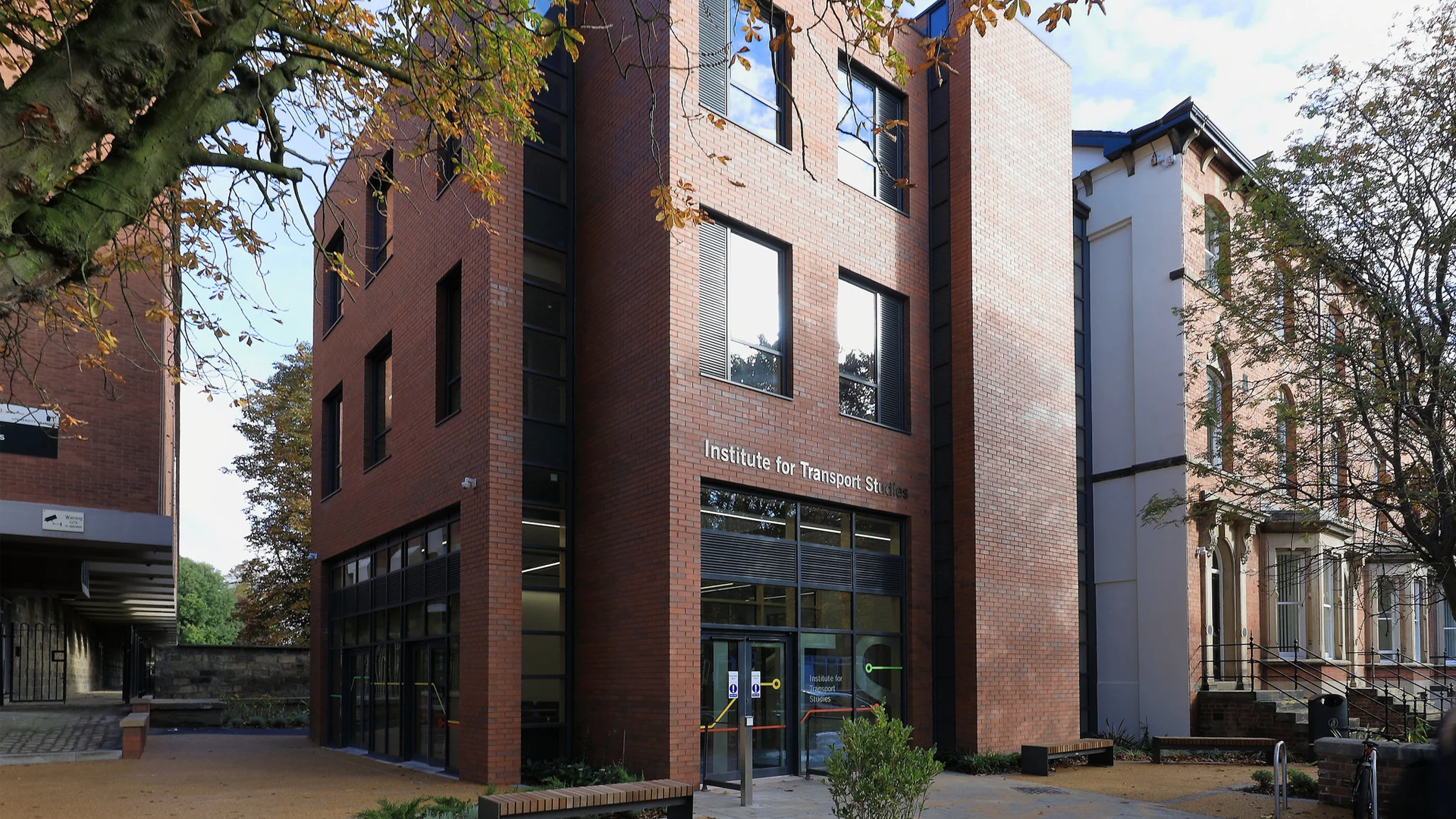
The Institute for Transport Studies at University of Leeds. Photo for Farrell and Clark by Greylock Photography.
What’s your background?
My original undergraduate degree was in philosophy and English literature at the University of Edinburgh. I then worked in natural heritage conservation for a decade, before going back to university to complete a Master’s Degree in Sustainable Rural Development at the University of Aberdeen. This had a number of different strands, from economics and planning to environmental impact assessment, sustainable transport and sustainable tourism.
I stayed in the geography department to do my PhD, which looked at transport governance in Scotland. At the time I didn’t know much about local government, so had to learn a new set of fields around political science and political geography.
As a postdoctoral researcher, my experience was quite interdisciplinary, because I worked in computer science, sociology and a business school. I’ve been at the Institute for Transport Studies for 10 years, and I’m a member and former chair of the Transport Geography Research Group at the Royal Geographical Society. Transport geographers do a lot of the same things as other transport researchers, but with a geographic perspective, in that concepts such as space, scale, place and territories are at the fore.
What do you hope to achieve at TransiT?
I’d like to see really clear understanding and progress on incorporating digital twin-derived insights into policy making.
This is a difficult challenge, partly because of the number of stakeholders and different levels at which transport policy decisions are formed and implemented.
Another part of the challenge is that there’s a very well-developed ‘cost benefit analysis’ approach to appraising whether a transport scheme deserves funding.
This is a decision-making system that I feel is slow to innovate. So the focus needs to be on improving policymaking at a strategic level.
