
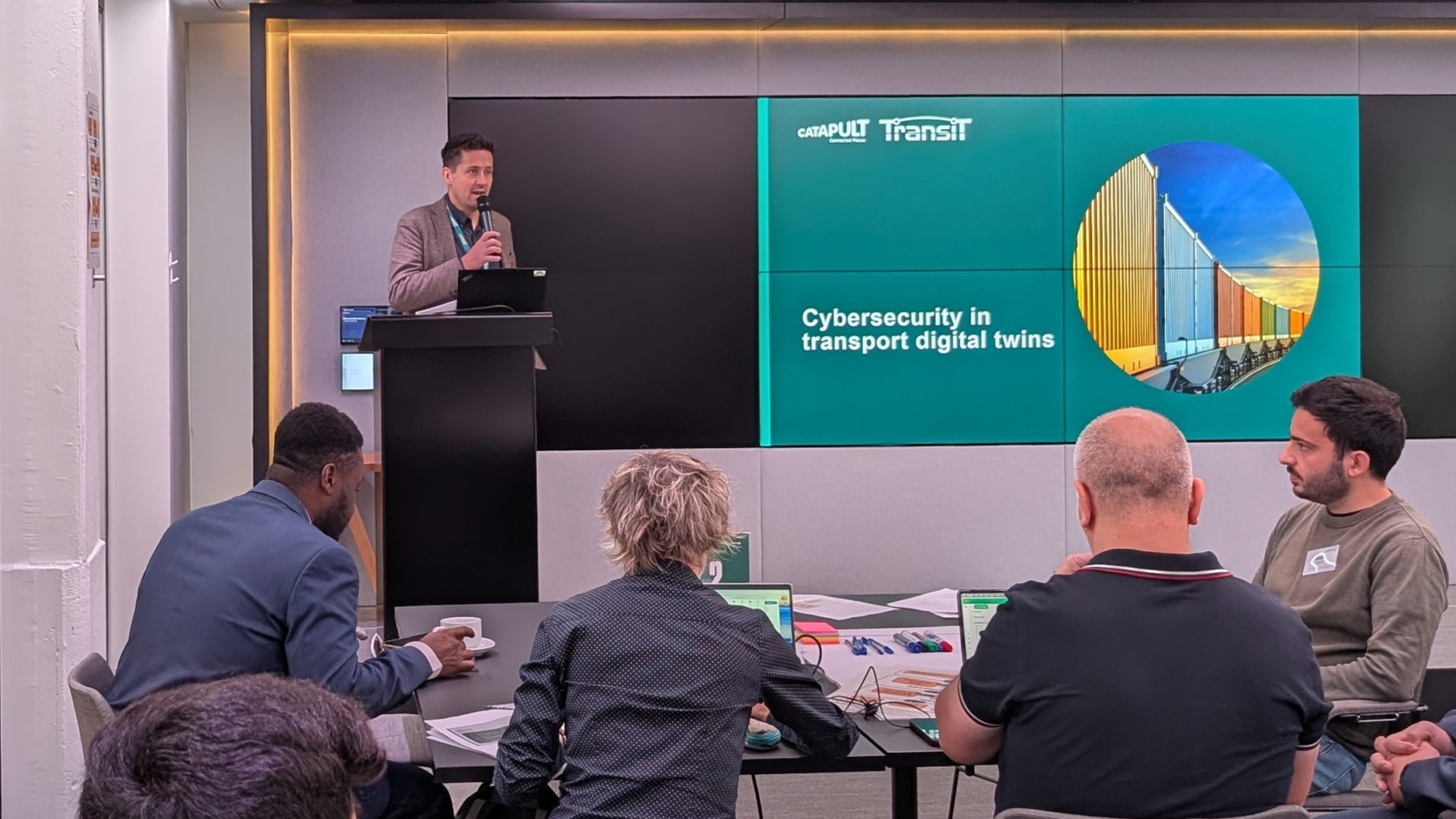
Transport cybersecurity in focus at industry digital twinning event
Researchers exploring cybersecurity risks in decarbonised transport gathered insights from industry last week in a workshop for UK research hub TransiT.
The London event was the first in a series being hosted for TransiT by Connected Places Catapult, the UK’s innovation accelerator for cities, transport and place leadership.
TransiT is using digital twins – digital replicas of the physical world – to identify low-risk, low-cost routes to zero emission transport in the UK. Its remit includes linking digital twins of different transport modes into ‘federations’, or networks, representing complex chains of the UK transport system, including road, rail, air and maritime, across both passenger and freight.
Our industry guests have brought lots of fresh thinking to our research and we’re looking forward to exploring this further.
Professor Dimitrios Pezaros, TransiT
The workshop focused on the cybersecurity risks of these connected transport twins, including what the potential threats might be, how they could be detected, how organisations would respond, and what safeguards or standards could help to defend against cyber attacks.
Chris Jones, Data and Digital Products Director at Connected Places Catapult, opened the event and said: “Digital twins can help us to optimise transport systems, explore ‘what if’ scenarios and understand the trade-offs between carbon costs and risks. So they are a huge opportunity. But there’s also the risk that digital twins expand the attack surface for malicious actors to potentially expose critical national infrastructure, disrupt services, impact safety and erode public trust. That’s why cybersecurity has to be a priority – and why collaborating with industry is vital.”
TransiT’s cybersecurity experts at University of Glasgow, Professor Dimitrios Pezaros and Dr Stefanos Evripidou, led the workshop sessions.
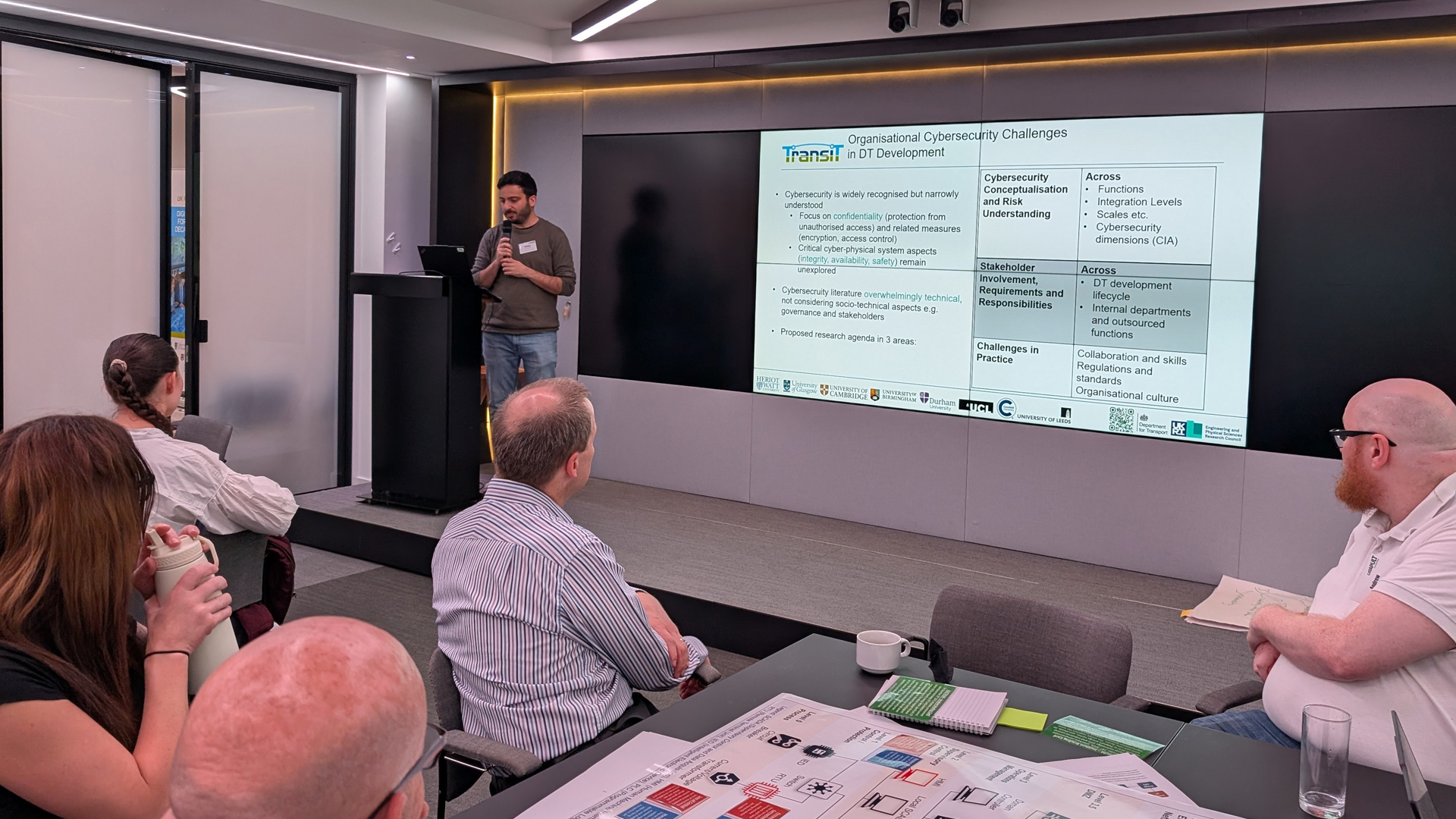
TransiT Researcher Dr Stefanos Evripidou presenting at the event.
Dr Evripidou said: “Digital twinning is increasingly being used to improve the efficiency and sustainability of transport. And a network of connected digital twins can let us explore decarbonisation scenarios across the whole transport system. But networks like these are also very new – and fraught with cybersecurity risks. That’s why a key part of our work at TransiT involves identifying and measuring these risks – including the potential cyber-physical impacts – and asking industry for their own insights and experiences.”
Guests at the event were asked to share insights into how their own industry was using digital twins, and to consider different attack scenarios that might affect them. These include false data injections, where the digital twin is fed fake data, or denial of service attacks, where critical data or systems become unavailable. Other threats include data leaks or loss of view and control, where operators or systems are no longer able to properly see or interact with system information through their normal interfaces.
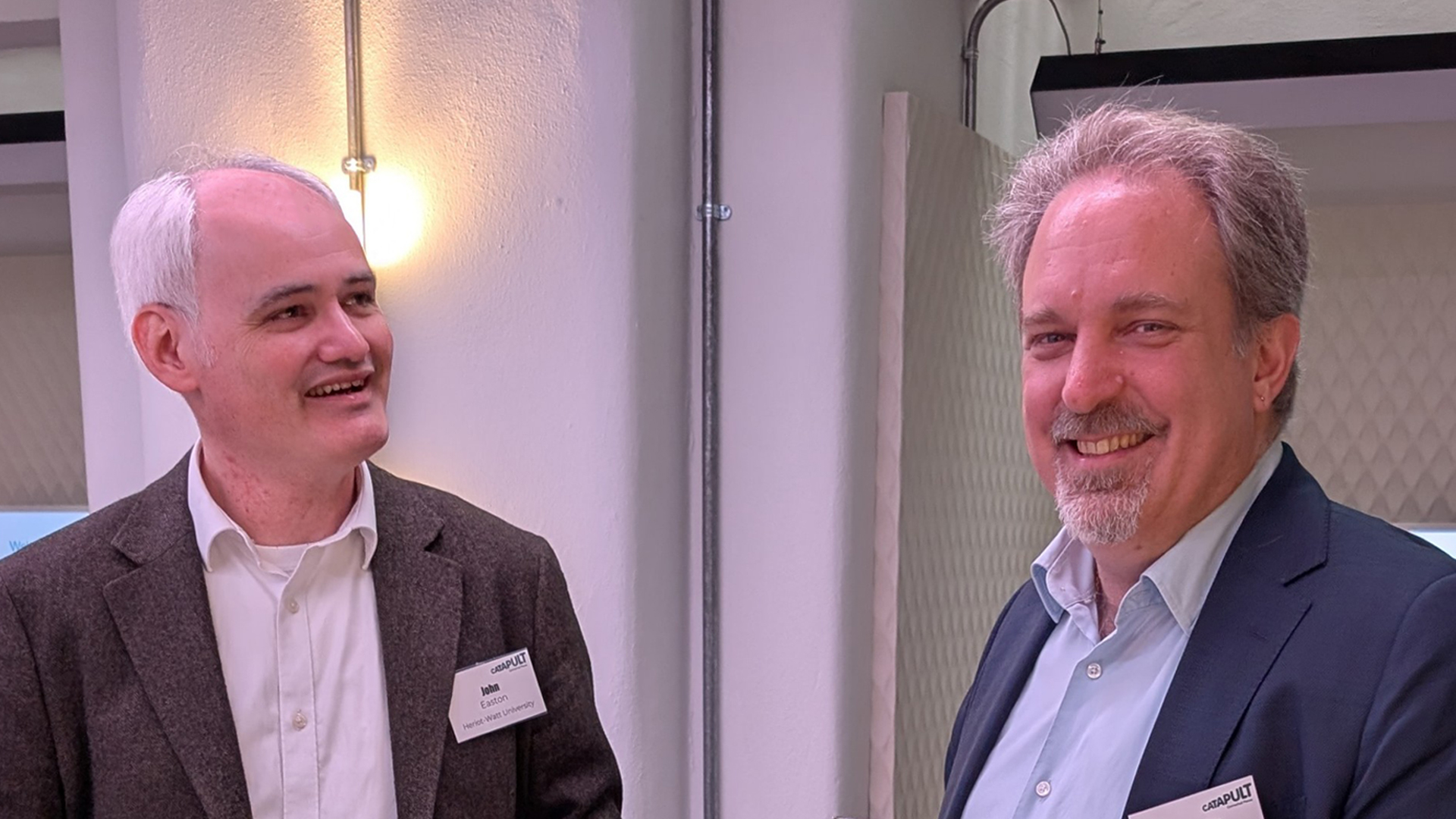
TransiT Co-Investigators Professor Dimitrios Pezaros and Professor John Easton at the cybersecurity event.
Summarising some key topics from the event, Professor Pezaros said: “We’ve heard today about the vulnerabilities of the digital twin ecosystem, about the challenge of understanding where potential cyber attacks are coming from, and about skills gaps in digital twinning, cybersecurity and industrial control systems that will need to be filled. But we’ve also heard about the opportunities that digital twins bring, from real-time data feeds to predicting what might happen in the physical world. Our industry guests have brought lots of fresh thinking to our research and we’re looking forward to exploring this further.”
The event included a keynote presentation from the National Cyber Security Centre (NCSC) about innovation and cybersecurity, and the challenges of making the UK the safest place to live and work online. NCSC leads the UK’s defence against the most advanced cyber threats, including those from nation states, hackers, and cyber criminals.
Other areas of TransiT research will be highlighted in another three Connected Places Catapult events. These are ‘Humans and digital twins in transport decarbonisation,’ ‘The cyber-physical transport architecture of the UK’ and ‘Designing for federation in digital twinning for transport.’
TransiT is a collaboration of eight universities and almost 70 industry partners, jointly led by Heriot-Watt University in Edinburgh and the University of Glasgow, and supported by the UKRI Engineering and Physical Sciences Research Council (EPSRC), the main funding body for engineering and physical sciences research in the UK, and by the UK government’s Department for Transport.

